
Picture Description and Discussion
Boeing 767 · LOT · Belly Landing
Look at the picture
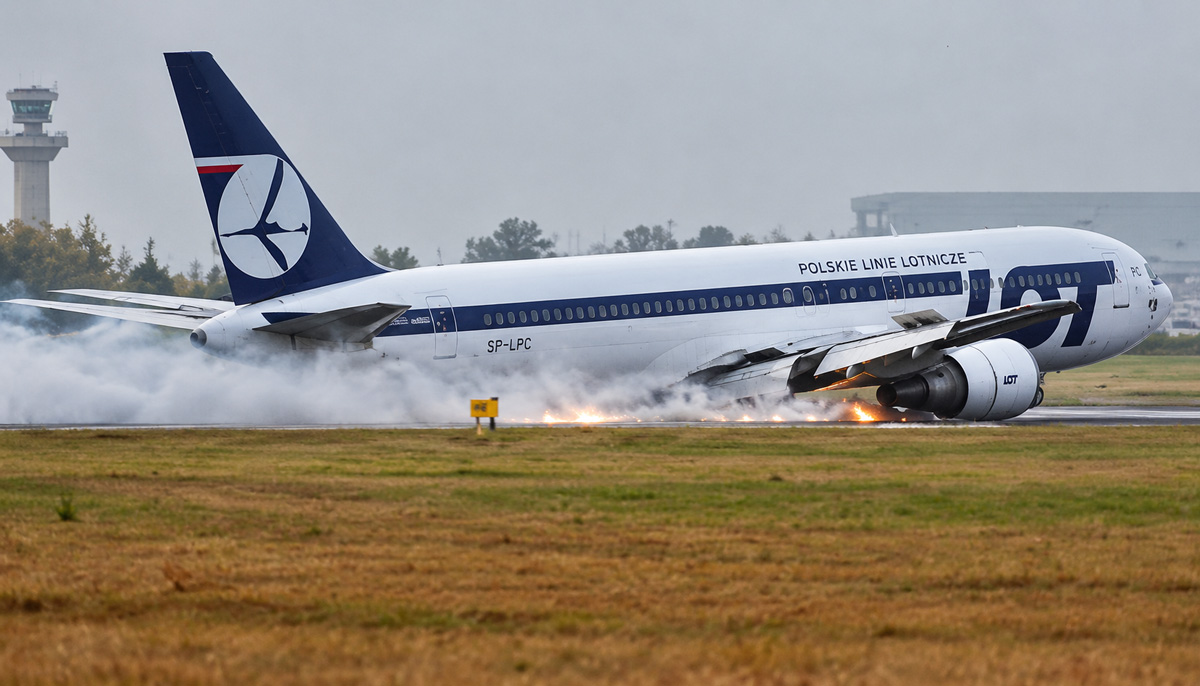
In this part, you will tell me what you can see in this picture and what you think is happening in it. After that, I will ask you some questions. Look at the picture carefully. You may take a few moments to think before you start talking. Are the instructions clear?
Describe the picture aloud before opening a model answer.
ICAO 4 · Suggested answerShow answer + audio
In this picture I can see a wide-body passenger aircraft, operated by LOT, performing a belly landing.
We can see some fire coming from (originating from) the engine and fuselage of the aircraft.
There is also some smoke behind of this aircraft caused by the friction on runway’s pavement.
It seems the aircraft is still moving along the runway when this picture was taken.
On the foreground of the picture I can see grass and a taxiway sign.
On the background of this picture, I can see a tower, some buildings and the weather seemed to be foggy.
ICAO 5 · Suggested answerShow answer + audio
This picture shows a wide-body twin-engined passenger jet operated by LOT, a Polish airline, carrying out (performing) a belly landing, which might have been caused after its landing gear failed to extend.
We can see some fire and sparks coming from (originating from) the lower engine cowling fuselage as the aircraft scratches its fuselage along the runway.
There is also quite smoke coming from (originating from) the back of this Boeing 767, which was certainly caused by friction along the runway pavement.
Furthermore, upon closer examination of the situation, it appears that the engines are suffering major abrasions, obviously caused by the belly landing while the aircraft is still moving along the runway.
To the best of my knowledge about this event, even though the fear and panic of everyone on board, the pilots landed the aircraft safely, and afterward, the passengers and crew disembarked without injuries.
What happened before the picture?
What do you think happened before this picture was taken?
What do you think the pilots were doing before this picture was taken?
What do you think was happening before this picture was taken?
Can you create a short story based on this picture? Use your imagination.
Listen, answer aloud, then reveal a model answer.
ICAO 4 · Suggested answerShow answer + audio
Before the picture was taken, the aircraft was facing problems to extend the landing gear,
because of this they had to performing a belly landing.
ICAO 5 · Suggested answerShow answer + audio
Before the picture was taken, the crew could have been encountering issues when trying to extend the landing gear.
Aside from that, the pilots could have been running the checklist and carrying out (performing) all the procedures to identify the problem, explore potential solutions, and take the necessary actions for a belly landing.
These actions may be: Executing a fuel jettison or holding some minutes to burn some fuel, thereby reducing the risk of fire during this critical procedure.
What will happen next?
What will happen after that?
Listen, answer aloud, then reveal a model answer.
ICAO 4 · Suggested answerShow answer + audio
After the aircraft stops completely on the runway, pilots will request fire and emergency services to support them.
ICAO 5 · Suggested answerShow answer + audio
After that, the aircraft will stop completely on the runway,
the emergency services will support them on putting out (extinguishing) the fire and on the emergency evacuation.
What causes sparks during a belly landing?
Why do sparks come below the aircraft when a belly landing is performed?
Listen, answer aloud, then reveal a model answer.
ICAO 4 · Suggested answerShow answer + audio
Sparks come below the aircraft due to the friction between the fuselage of the aircraft and the runway’s pavement.
ICAO 5 · Suggested answerShow answer + audio
The sparks come out (emerge) because the fuselage suffers some friction alongside the runway’s pavement causing heating and producing sparks and fire.
How can fuel dumping help?
To what extent the fuel dumping helps in case of a belly landing?
Listen, answer aloud, then reveal a model answer.
ICAO 4 · Suggested answerShow answer + audio
Fuel dumping is very important to decrease all risks of flames and explosions during a belly landing procedure.
ICAO 5 · Suggested answerShow answer + audio
Fuel dumping helps increase safety during belly landings.
By following this procedure, pilots can prevent serious damage caused by the impact of the aircraft on the ground, especially when the aircraft has full tanks.
The risks of flames and explosions are drastically reduced with a lower level of fuel in the tanks, thereby decreasing the potential life-threatening situation for people on board.
Runway foam and belly landings
Now, I am going to read a statement to you and then you will have to tell me to what extent you agree or disagree with it. “It’s known foam being applied along the extension of the runway length mitigates the fire threatening during a belly landing, but in another hand, it might cause a runway excursion easier than without it on the asphalt resulting in incidents or even accidents.”
Listen, answer aloud, then reveal a model answer.
ICAO 4 · Suggested answerShow answer + audio
I disagree with this statement because foam is not used anymore!
Foam was considered more problem than solution, because it was very hard to stop the aircraft safely with the use of it, resulting a lot of runway excursion due to the decreasing of braking action on the runway.
ICAO 5 · Suggested answerShow answer + audio
I disagree with this statement because foam has not been in use for decades on a belly landing!
Apart from the time wasted in applying it on the runway, it may also add to (increase) the difficulties in bringing the aircraft to a safe stop on the runway’s perimeters, thereby diminishing the braking action and heightening the runway excursion risks.